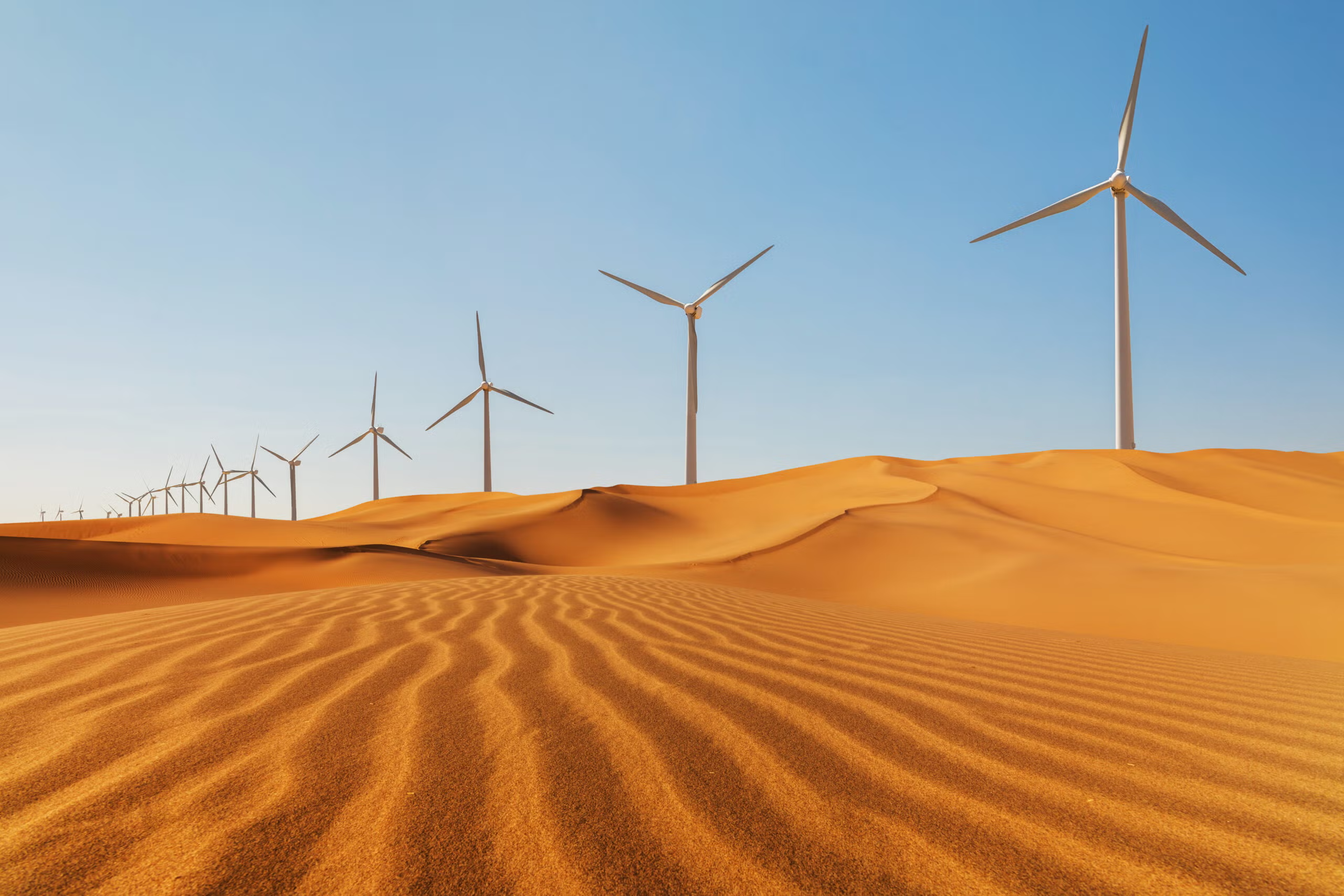
The African Development Bank has helped structure a major financing deal to expand renewable energy capacity in Egypt, bringing in European institutional investors to support one of Africa’s largest wind power projects.
The bank announced on Friday that it had completed its first joint transaction with ILX Management, an Amsterdam-based asset manager, under a model designed to attract long-term institutional capital into African infrastructure.
Under the arrangement, ILX invested US$40 million into a US$140 million loan structured by the African Development Bank (AfDB) to finance a 1.1 gigawatt wind project in Egypt.
The broader project, located along the Gulf of Suez, has an estimated value of about US$1.1 billion and is being developed by Saudi utility giant ACWA Power under a 25-year power purchase agreement with the state-owned Egyptian Electricity Transmission Company.

The agreement guarantees long-term electricity offtake, providing revenue certainty for investors.
More Read

The financing uses a “funded risk participation” model, in which a development bank shares both funding exposure and credit risk with institutional investors. In this case, ILX assumes part of the loan exposure alongside the AfDB.
The structure is designed to unlock participation from European pension funds and other long-term investors that typically avoid direct exposure to complex infrastructure projects in emerging markets.
AfDB officials say the model is part of a broader push to close Africa’s infrastructure financing gap by crowding in private capital.


“The private sector is an essential catalyst for Africa’s growth; without its integration, sustainable and inclusive development remains out of reach,” said AfDB President Sidi Ould Tah.
The Suez wind project is one of the largest renewable energy installations in Egypt’s pipeline and is expected to significantly expand the country’s clean energy capacity once completed.
The AfDB approved financing of up to $170 million for the project in December 2024, as part of its wider climate investment strategy.
The wind farm is expected to play a key role in reducing Egypt’s reliance on fossil fuels, particularly natural gas, while also lowering energy import costs.
It aligns with Egypt’s national energy transition plan, which targets renewables to account for 42 percent of electricity generation by 2030 and 60 percent by 2040, according to the State Information Service.
Officials say the project will also help stabilise the country’s power supply and support industrial growth by expanding access to low-carbon electricity.
More Read

Beyond its domestic impact, the deal signals growing momentum in efforts by multilateral development banks to structure blended finance solutions that reduce risk for institutional investors.
The partnership between AfDB and ILX, signed in 2023, is focused on scaling up non-sovereign, climate-aligned investments across Africa.

Analysts say the transaction could serve as a template for future deals, particularly as African governments and development finance institutions look to mobilise private capital for large-scale energy and infrastructure projects.
With energy demand rising across the continent, such blended financing models are increasingly seen as critical to bridging funding gaps while accelerating the transition to cleaner power systems.