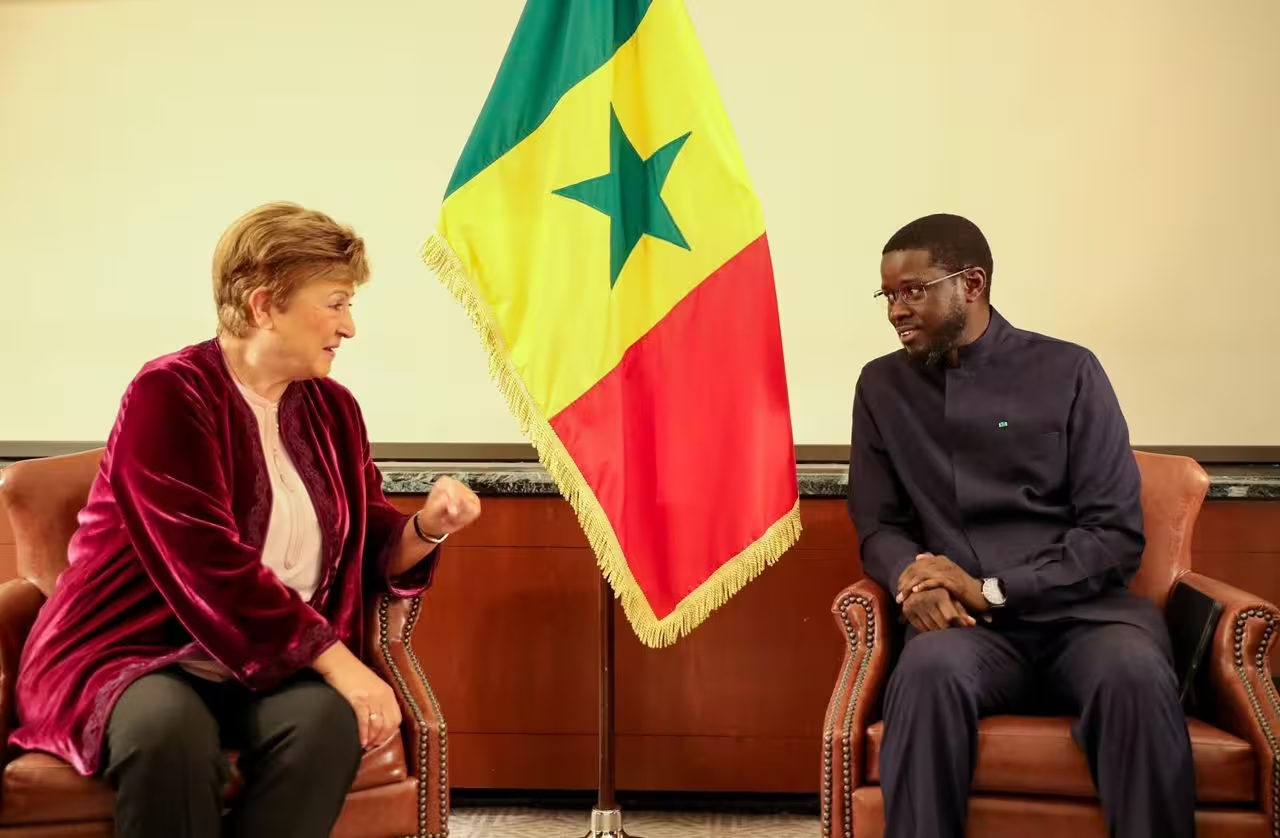
International Monetary Fund Managing Director Kristalina Georgieva on Friday urged North African countries to “supercharge” trade and investment ties with sub-Saharan Africa and Europe, saying stronger regional integration could raise the region’s economic output by more than seven percent.
Speaking at the North Africa: Connecting Continents, Creating Opportunities conference in Algiers, Georgieva said heightened global uncertainty, shifting supply chains and rapid advances in artificial intelligence were reshaping the economic landscape.

“We meet at a moment of profound global transformation,” she told policymakers and business leaders, warning that uncertainty was likely to remain elevated and become “the new normal”. “It is precisely at such moments that cooperation is needed the most.”
Georgieva said North Africa was well placed to benefit from geopolitical realignments and changing trade routes, citing its geographic proximity to Europe and deepening ties within Africa, including under the African Continental Free Trade Area.
Her central message to leaders was clear: “Supercharge this integration.”
More Read

The IMF chief outlined a vision of North Africa as a manufacturing and logistics hub linking European and sub-Saharan African markets. She pointed to opportunities for developing cross-regional infrastructure, including railway and highway corridors, as well as expanding energy cooperation.
“With abundant solar and wind resources, North Africa can power industries at home and abroad—supporting Europe’s energy transition, alleviating Africa’s electricity gaps,” Georgieva said, noting that some 600 million people in sub-Saharan Africa still lack access to electricity.
She cited Algeria as an example of efforts to diversify energy partnerships, pointing to hybrid solar-gas projects, electricity interconnections with Europe and ambitions to export green hydrogen.
More Read

To unlock the region’s potential, Georgieva proposed three priority actions.
First, she called for reducing trade barriers. Average import tariffs in North Africa stand at around seven percent, she said, higher than in blocs such as the European Union and the Association of Southeast Asian Nations. Intra-African trade remains limited, accounting for roughly four percent of North African exports and one percent of imports, according to IMF data.
Second, she urged structural reforms to improve the business climate, including modernising ports and customs systems and upgrading major transport corridors such as the Trans-Maghreb and Cairo-Dakar highways to strengthen connectivity across the region.
Third, Georgieva stressed the importance of investing in human capital through vocational training, digital skills and artificial intelligence education, alongside stronger health systems, to ensure growth is inclusive and resilient.
A new IMF report released at the conference estimates that implementing such reforms could increase North Africa’s exports by 16 percent and raise gross domestic product by more than seven percent, equivalent to an additional $67 billion in economic output. The gains would also generate spillover benefits for sub-Saharan Africa and Europe through expanded trade and investment flows.
Georgieva concluded her remarks with an Arabic proverb “El yed el wahda ma tsaffeq,” or “one hand does not clap” to underscore the need for collective action.
More Read

“In times of sweeping transformations, cooperation is not optional, it is essential,” she said.
The conference in Algiers has brought together officials and business representatives from North Africa, sub-Saharan Africa and Europe to explore ways of translating integration ambitions into concrete projects and policy reforms.
Background to North Africa
North Africa occupies a strategic position at the crossroads of Europe, the Middle East and sub-Saharan Africa, yet trade integration within the region and with the rest of the continent remains relatively limited compared with other parts of the world.
The five North African economies — Algeria, Egypt, Libya, Morocco and Tunisia — have traditionally oriented much of their trade toward Europe. The European Union is the region’s largest trading partner, particularly for energy exports, manufactured goods and agricultural products.
At the same time, intra-regional trade among North African countries remains modest, partly due to longstanding political tensions and incomplete economic integration. The Arab Maghreb Union, founded in 1989 to promote economic cooperation among Maghreb states, has made limited progress toward creating a fully functioning common market.
Beyond the Maghreb, North African countries are also signatories to the African Continental Free Trade Area, which entered into force in 2021 with the aim of creating a single African market for goods and services. The agreement seeks to reduce tariffs, harmonise trade rules and boost intra-African commerce across 54 countries. However, implementation has been gradual, and non-tariff barriers including customs delays, regulatory differences and infrastructure gaps continue to constrain trade flows.
According to data cited by the International Monetary Fund, intra-African trade accounts for a relatively small share of North Africa’s exports and imports compared with other regional blocs. By contrast, trade within the European Union and among members of the Association of Southeast Asian Nations is significantly higher as a proportion of total commerce.
Energy is a central pillar of North Africa’s external economic relations. Algeria and Libya are major oil and gas producers, while Egypt has emerged as a regional gas hub in the eastern Mediterranean. Morocco and Tunisia, though energy importers, are investing in renewable energy projects, particularly solar and wind, to reduce dependency and attract green investment.
In recent years, geopolitical shifts — including supply chain reconfiguration after the COVID-19 pandemic and the war in Ukraine — have prompted European governments and companies to seek “nearshoring” opportunities closer to home. North Africa’s proximity to southern Europe, relatively competitive labour costs and expanding industrial zones have positioned it as a potential beneficiary of this trend.
Manufacturing sectors such as automotive assembly, textiles, fertilisers and food processing have grown in several countries, especially Morocco and Egypt. Improved logistics links including ports on the Mediterranean and Atlantic coasts have supported export-oriented industries, though cross-border land connectivity within North Africa remains uneven.
The region also faces structural challenges. Youth unemployment rates are among the highest globally, and labour market participation particularly for women remains below global averages. Public debt levels have risen in several countries following pandemic-related spending and external shocks, limiting fiscal space for large-scale public investment.
Infrastructure gaps, complex customs procedures and inconsistent regulatory frameworks continue to impede trade expansion. Economists argue that deeper integration through tariff reduction, streamlined border processes and coordinated infrastructure development could unlock economies of scale, attract foreign direct investment and strengthen resilience to external shocks.
Against this backdrop, calls from international institutions for stronger Africa-Europe and intra-African integration reflect a broader push to reposition North Africa as a bridge between continents, leveraging its geography, energy resources and human capital to generate more diversified and sustainable growth.