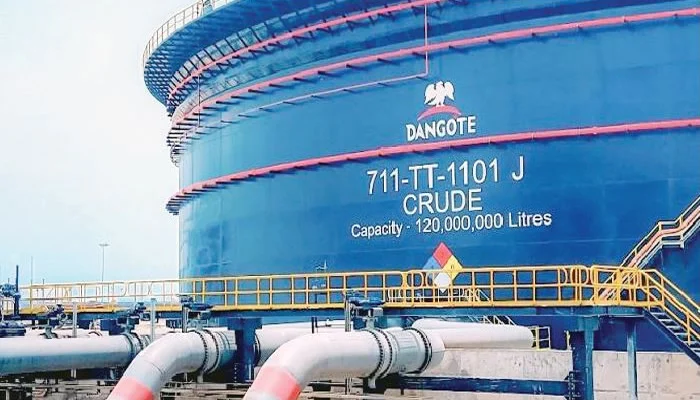
Nigeria’s Dangote Refinery has achieved its full nameplate capacity of 650,000 barrels per day (bpd), the facility announced Wednesday, becoming the first single-train refinery in the world to reach such production levels.
The Lagos-based facility, owned by billionaire industrialist Aliko Dangote, reached the milestone after extensive optimization of its crude distillation and gasoline production units. Intensive 72-hour performance tests were conducted with technology partner UOP to verify efficiency and confirm operational stability across the refinery’s production blocks. David Bird, the refinery’s general manager, said the achievement demonstrates the facility’s “resilience and advanced engineering.”

“Our teams have shown exceptional precision and expertise in stabilizing both the CDU and gasoline production block. This milestone underscores the strength, reliability, and engineering quality that define our operations,” Bird said. He added that the refinery is committed to producing high-quality refined products that will reduce Nigeria’s import dependence and position the country as a net exporter of petroleum products.
With full operations, the refinery can deliver up to 75 million liters of gasoline per day to the domestic market, up from 45 to 50 million liters supplied during recent holidays. Analysts project that the 650,000-bpd capacity could save Nigeria up to US$10 billion annually in foreign exchange by reducing refined product imports, which currently account for more than 80 percent of domestic fuel consumption. The refinery is also expected to stabilize supply, limit price volatility, create thousands of jobs, strengthen the naira, and boost downstream industries including petrochemicals, fertilizers, and plastics.
The Dangote Refinery’s units now operating at full capacity include crude distillation, gasoline production, naphtha treatment, isomerization, and reformer units. Other treatment units are set for performance testing in Phase 2 next week.


Aliko Dangote previously announced plans to expand capacity to 1.4 million bpd, supporting additional petrochemical production, including linear alkylbenzenes and base oils, and increasing annual polypropylene output from one to 1.5 million metric tons. The refinery, which was commissioned in phases starting in 2022, is Africa’s largest single-site refining facility.
Nigeria, Africa’s largest crude oil producer, has long relied on imported refined petroleum products due to insufficient domestic refining capacity. Persistent fuel shortages and high import costs have strained the economy, leading to widespread supply disruptions and inflationary pressures. The Dangote Refinery, built at an estimated $19 billion, was designed to meet domestic demand and export surplus refined products to regional markets in West Africa.

Experts say the facility could transform Nigeria’s energy landscape by significantly reducing import dependency, boosting foreign exchange savings, and improving energy security. The refinery is expected to serve as a model for large-scale industrial projects on the continent, combining advanced technology, operational efficiency, and local content development.
The refinery’s full capacity milestone is also strategically significant for Nigeria’s downstream petroleum sector. By supplying sufficient fuel to meet domestic demand, the facility can help stabilize market prices and support industrial growth. Petrochemical and fertilizer production is expected to expand, offering new opportunities for job creation and technological development.
Nigeria’s government has welcomed the milestone as a major step toward regional energy leadership. Analysts note that with full operations, the Dangote Refinery strengthens Nigeria’s position in West African and global markets, offering the country an opportunity to become a major exporter of refined products while supporting sustainable industrial development.
The refinery’s performance underscores the importance of large-scale infrastructure projects in transforming African economies, demonstrating that private investment, technological expertise, and strategic planning can collectively address long-standing energy and economic challenges.
The Dangote Refinery, located in the Lekki Free Trade Zone near Lagos, Nigeria, is the largest single-train refinery in the world, designed to process 650,000 barrels per day (bpd) of crude oil. Conceptualized by Nigerian billionaire Aliko Dangote in 2013, it is part of the larger Dangote Industrial City, a US$20 billion industrial complex aimed at transforming Nigeria into a self-sufficient, industrialized economy.

The refinery is designed to produce a full range of refined products, including gasoline, diesel, kerosene, polypropylene, and liquefied petroleum gas. Prior to its commissioning, Nigeria, despite being Africa’s largest crude oil producer, imported over 80 percent of its refined petroleum products, leading to fuel shortages and high domestic prices. The refinery’s output is expected to drastically reduce import dependence, saving the country up to US$10 billion annually in foreign exchange.
In addition to fuels, the refinery feeds petrochemical production, including polypropylene, linear alkylbenzene, and base oils, supporting the domestic manufacturing sector and reducing reliance on imports for plastics, detergents, and lubricants. The complex is designed to handle all stages of crude refining, from distillation to treatment and blending, featuring advanced technologies sourced from global partners such as UOP (Honeywell) and KBR.
The project has faced multiple delays since its announcement, primarily due to technical challenges, infrastructure development, and financing. Its commissioning in 2023 marked a historic milestone, as it became the first single-train refinery to reach full nameplate capacity of 650,000 bpd, producing up to 75 million liters of gasoline per day at peak operation. This milestone represents a turning point for Nigeria’s energy sector, enabling the country to become a net exporter of refined products in the West African subregion.
Background to Dangote Refinery
The refinery’s strategic location in the Lekki Free Trade Zone allows for easy access to domestic and international markets. It is expected to serve not only Nigeria but neighboring countries such as Benin, Togo, and Ghana, strengthening regional energy security. The project is also a major employment generator, creating thousands of jobs in construction, operations, logistics, and downstream industries.
Plans are underway to expand capacity to 1.4 million bpd, which would make Dangote Refinery one of the largest integrated refineries globally. The expansion will support additional petrochemical units, including fertilizers, lubricants, and polypropylene, positioning Nigeria as a hub for refined products and petrochemicals in Africa.
Beyond economic impact, the refinery contributes to fuel stability and price moderation, reducing volatility in domestic fuel markets and eliminating recurring shortages that have historically affected consumers. Analysts view the refinery as a cornerstone for Nigeria’s industrialization strategy, enabling value addition to crude oil, fostering local content development, and supporting the nation’s transition toward sustainable energy and industrial growth.
In essence, the Dangote Refinery is not just a refinery—it is a transformational infrastructure project designed to redefine Nigeria’s energy independence, industrial capacity, and regional trade footprint.